Your assistant answers confidently and wrongly, and every fix is a prompt tweak nobody can verify.
Retrieval ignores permissions: anyone who can ask a question can surface documents they could never open directly.
The pilot worked on 50 documents and fell over on 50,000, and nobody can say whether the problem is chunking, ranking, or the data itself.
Score before building
With your domain experts, we build a ground-truth set of real questions and the documents that answer them. Whatever retrieval you have today gets baselined against it, so every later decision has a number behind it.
Choose managed or custom by measurement
Bedrock Knowledge Bases, Azure AI Search, Vertex AI, or a custom pipeline: the query set decides. If a managed service scores well on your data, you get the cheaper system to run.
Build with permissions and freshness designed in
ACL-aware retrieval, citations on every answer, deletion workflows, and reindexing on your update cadence. Access control is part of the retrieval path, never a filter bolted on afterwards.
Hand over the evaluation, along with the pipeline
The scored suite stays with your team, so a future change to chunking, models, or data is measured the same way ours were.
RAG or GraphRAG?
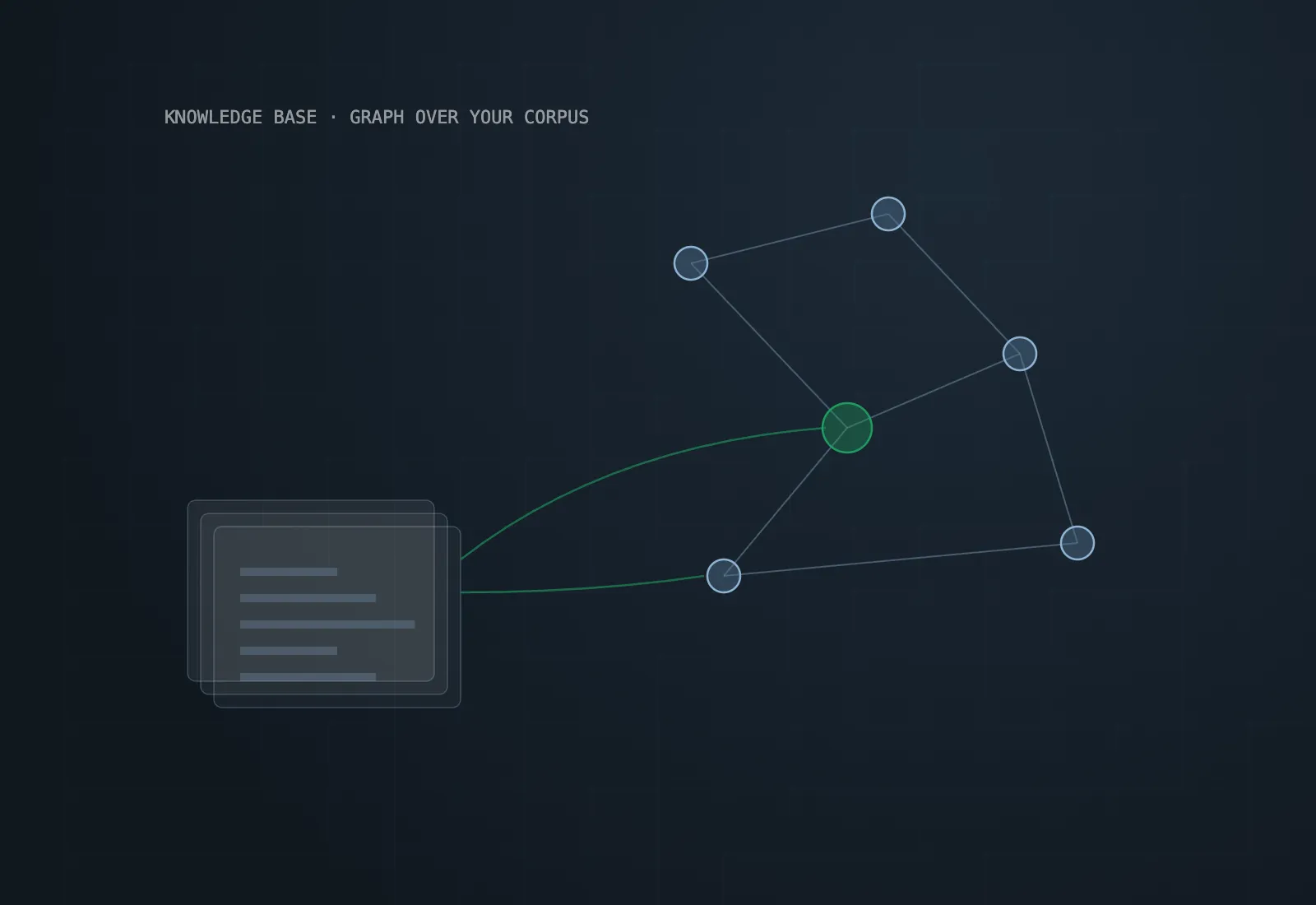
GraphRAG earns its complexity when answers require joining facts across documents: org structures, contracts that reference other contracts, multi-hop questions. If plain retrieval scores well on your query set, we ship the simpler system and say so.
What accuracy can we expect?
We will not quote a number before seeing your data, and you should distrust anyone who does. The first deliverable is a baseline on your documents and your questions. Targets get agreed from there, in writing.
What happens when documents change or leave?
Deletions and permission changes propagate to the index, which matters for offboarding, legal holds, and stale answers. That path is designed at the start, because retrofitting it is where most RAG systems quietly leak.